
Application engineering
PTO Shaft Planning for Canadian Snowblowers
Selection notes for tractor snowblowers, with explicit separation between catalogue evidence and application-specific engineering checks.
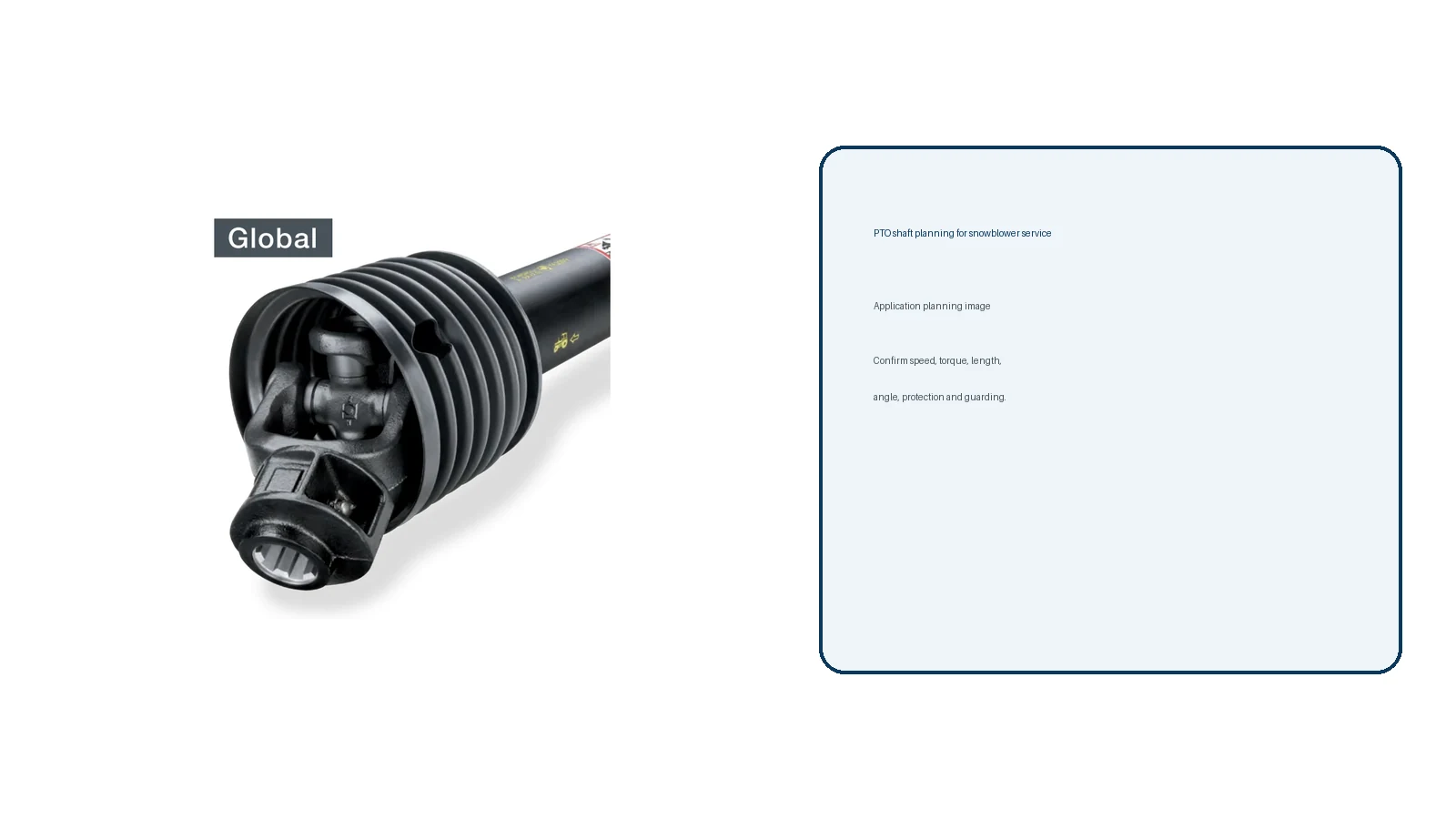
PTO Shaft Planning for Canadian Snowblowers requires a system-level review rather than a visual replacement. The driveline must transmit the required torque while moving through the tractor and implement geometry without bottoming, separating or contacting the hitch. For tractor snowblowers, the main engineering concerns include cold-weather guarding, ice contamination, short hitch geometry and seasonal storage.
Data required before selection
Record PTO speed and spline, implement input connection, minimum and maximum cross-to-cross distance, normal and maximum joint angle, power or torque, starts per hour, hours per season, reversal, overload events and environmental exposure. Include photographs with a scale and any existing markings, but do not rely on the photo alone.
Geometry check
Measure the driveline at every critical hitch position. The minimum distance controls bottoming risk; the maximum distance controls telescoping overlap. Turning and lifting can occur together, so check the combined movement. A wide-angle head can support powered turns but still needs sufficient tube overlap and guard clearance.
Protection strategy
Choose the protection device by failure mode. A friction clutch addresses controlled slip, a ratchet limiter addresses intermittent overload, a shear bolt provides sacrificial release, and an overrunning clutch prevents coast-down inertia from back-driving the tractor side. More than one function may be needed, but each device must be selected and oriented correctly.
Canadian operating environment
Moisture, freeze-thaw cycles, fertilizer, road salt, wash water and long off-season storage can change the maintenance plan. Grease fittings should be cleaned before service. Guards, chains, locking pins, cross bearings and telescoping profiles should be inspected before each season and after impact or blockage.
Commissioning
With the PTO stopped, move the hitch through its complete range. Verify positive locking, correct phasing and free guard rotation. Lubricate required points before start-up. Begin the powered test at low load where the machine procedure allows, then stop and investigate any unusual vibration, noise, heating or repeated limiter activation.
RFQ checklist
- Machine make, model and serial range.
- PTO speed, spline and rotation.
- Implement input details.
- Minimum and maximum working length.
- Normal and maximum angle.
- Power, torque and duty cycle.
- Protection-device function.
- Photos and drawings.
Engineering RFQ
Send the operating data, not only a photo
For a reliable selection, include PTO speed, tractor and implement connections, compressed length, required extension, normal and maximum angle, power or torque, duty cycle and the required protection device.
Email: [email protected]
Canada correspondence address: 10990 Hogarth Dr, Richmond, BC V7E 3Z9, Canada